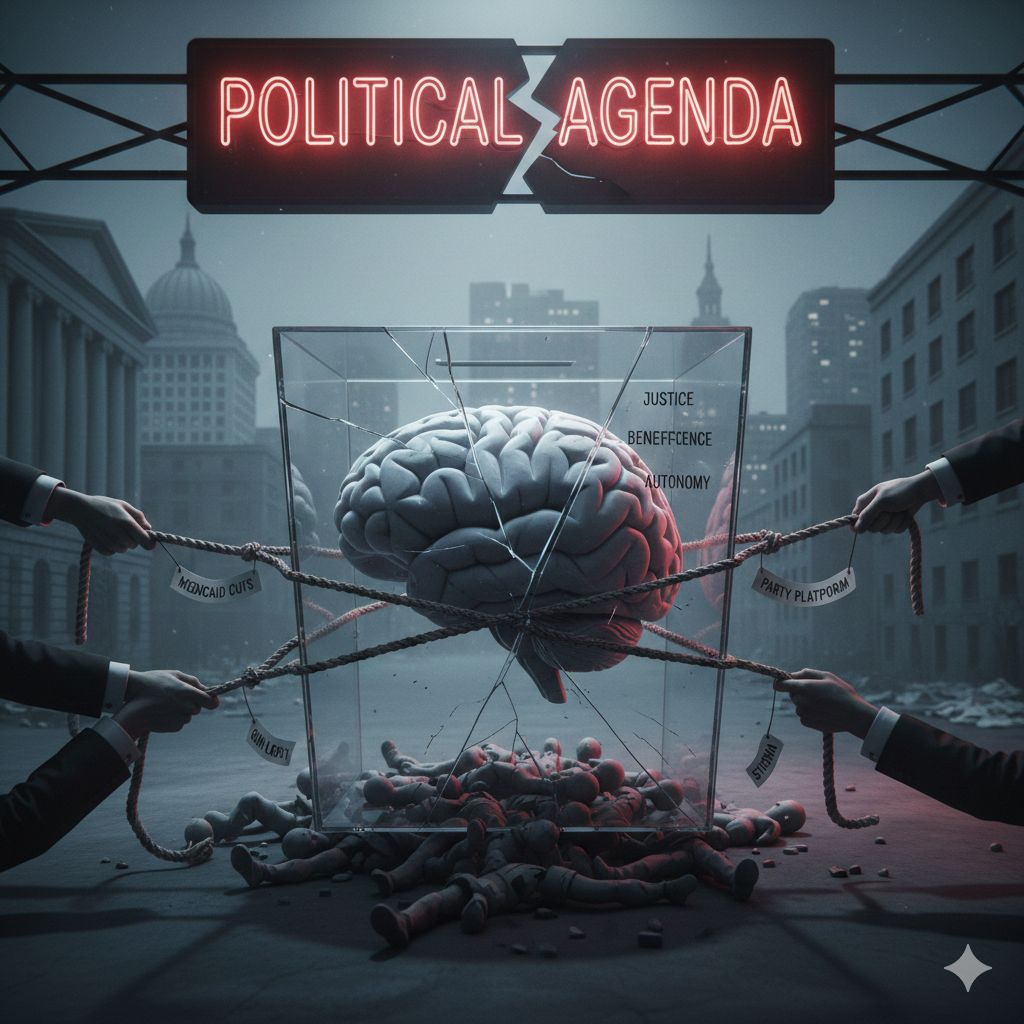
The Politicization of the Mind: An Ethical Crisis in Mental Health Care
The state of mental health care is not merely a clinical challenge—it is a deeply political one. While policy and funding mechanisms are inherently political processes, the current system’s entanglement with partisan agendas has created a profound ethical crisis, fundamentally compromising the principles of justice, beneficence, and autonomy that should govern patient care.
The Ethical Problem: Where Political Agendas Undermine Care
When mental health becomes a political instrument, the focus shifts from patient well-being to public relations, cost containment, or partisan advantage. This politicization manifests in several ethically problematic ways:
- Inequity in Access and Resources (Justice):
- Funding Disparities: Political decisions, such as restricting the expansion of public health insurance, directly limit access to necessary care for the most vulnerable populations. This fosters a two-tiered system where the severity of one’s mental illness often yields to socioeconomic status or geographic location. Ethically, this violates the principle of Justice, which mandates that health care resources be distributed fairly and equitably based on need.
- Stigmatization for Political Gain: Following acts of public violence, political narratives frequently exploit mental illness, creating misleading and harmful associations between mental health conditions and dangerousness. This perpetuates stigma, which in turn discourages individuals from seeking treatment and justifies reduced funding or restrictive policies.
- Compromising Treatment Integrity (Beneficence and Non-Maleficence):
- Agenda-Driven Policy: Specific political ideologies can influence which treatments are prioritized or which patient populations receive focus. Policy debates centered solely on criminal justice aspects of mental illness, for example, can lead to over-incarceration or forced treatment, rather than the development of comprehensive, community-based, recovery-oriented care.
- Misuse of Diagnosis: Historically, psychiatric diagnoses have been weaponized to silence or discredit political opponents or dissenters. This is an egregious violation of Non-Maleficence (the duty to do no harm) and transforms a healing profession into an instrument of state control. The existence of professional standards, such as the Goldwater Rule, underscores the danger of this politicization.
- Erosion of Trust and Autonomy:
- The Therapeutic Relationship: When clinicians feel pressure from political forces regarding diagnostic standards, resource allocation, or patient advocacy, the fundamental trust within the therapeutic relationship is compromised.
- Undermining Patient Voice: Policies driven by political, rather than clinical, imperatives often fail to prioritize the lived experience of individuals with mental illness. When budget cuts or restrictive laws limit options like long-term therapy or supportive housing, the patient’s Autonomy—their right to self-determination and choice in their treatment—is severely curtailed.
The Imperative for Separation
The integrity of mental health care hinges on its decisive separation from partisan political agendas. This is not a call for clinicians to abandon advocacy—they have an ethical obligation to champion systemic improvement—but rather a demand to shield clinical practice and resource allocation from ideological manipulation.
Why is this separation essential?
- To Uphold Core Ethical Principles: A non-politicized system ensures that every decision, from funding a community clinic to providing an individual diagnosis, is grounded in the principles of Beneficence (acting solely in the patient’s best interest) and Justice.
- To Prioritize Evidence-Based Policy: Mental health care must be informed by scientific research and clinical expertise, not by short-term political expediency or sensationalized news cycles. Separation allows for the adoption of evidence-based policies that address the social and political determinants of health rather than simply managing symptoms.
- To Promote Health Equity: When the discourse around mental health is elevated above partisan conflict, it becomes possible to dismantle the pervasive stigma that is often politically expedient to maintain. This focus allows for policies that promote genuine health equity by addressing the specific barriers faced by marginalized and underserved communities.
Ultimately, the goal is to treat mental health as an integral component of human well-being and a public good, not as a political bargaining chip. Only when the focus is exclusively on the health and rights of the individual can the mental health system fulfill its ethical mandate to heal, support, and empower.
 Anamolous Advocacy